

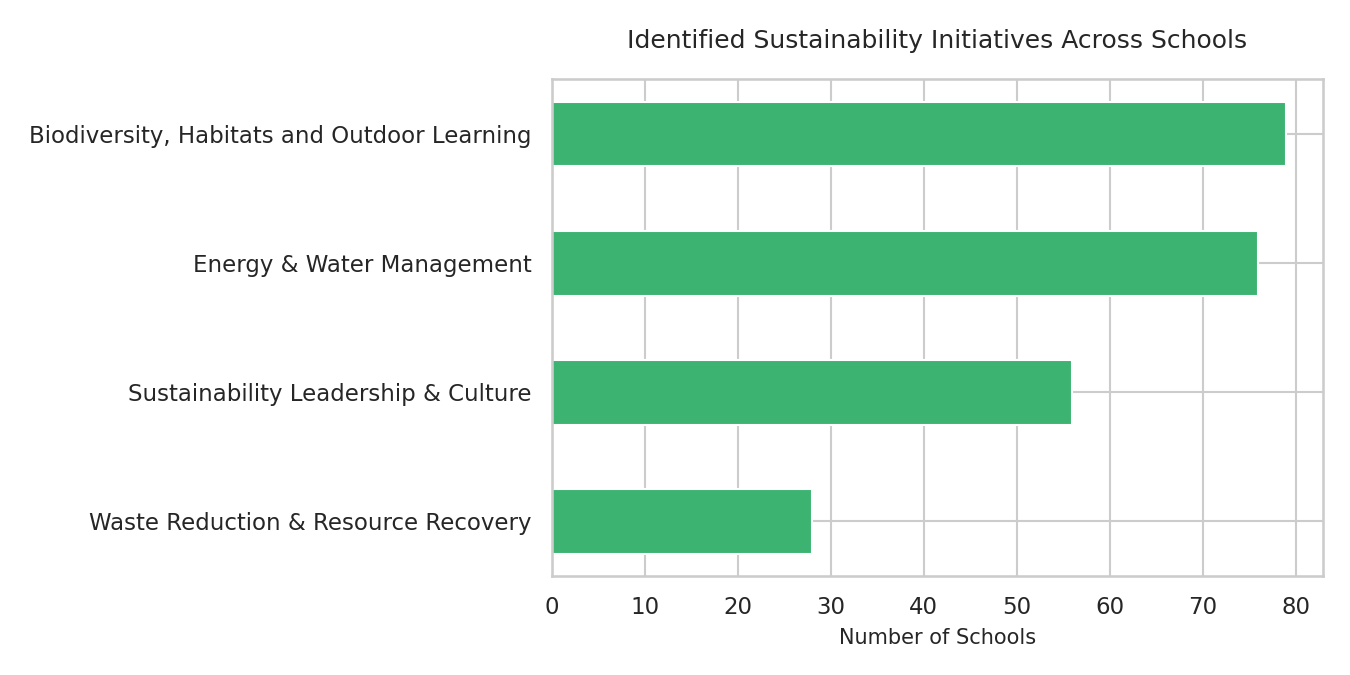
Biodiversity, habitats and outdoor learning is the most promoted theme, found on the websites of 79 of the 102 schools reviewed. Energy and water follows closely at 76 schools, driven by state programs: 62% of schools publicise LED lighting upgrades and 55% the Cooler Classrooms program. Waste reduction is the least promoted, at 28 schools.
Illawarra schools are strongest on gardens, outdoor learning and recycling. The biggest gaps are whole-school planning, Caring for Country, and everyday energy, water and waste practices. Survey percentages below are the share of responding educators.
Theme | Strengths | Gaps |
|---|---|---|
Biodiversity, habitats and outdoor learning | Half of educators report well-established outdoor learning areas (50%) and use of nearby bushland (50%). 65% have a garden program that is well established or starting. | Bushland regeneration is absent at 65% of schools. 46% of educators are unsure whether their school has a Caring for Country program. |
Energy, water and infrastructure | 38% report well-established solar panels. | 45% report no solar panels. Energy-saving practices are absent at 48% and water-saving practices at 50%. Active transport programs are absent at 68%. |
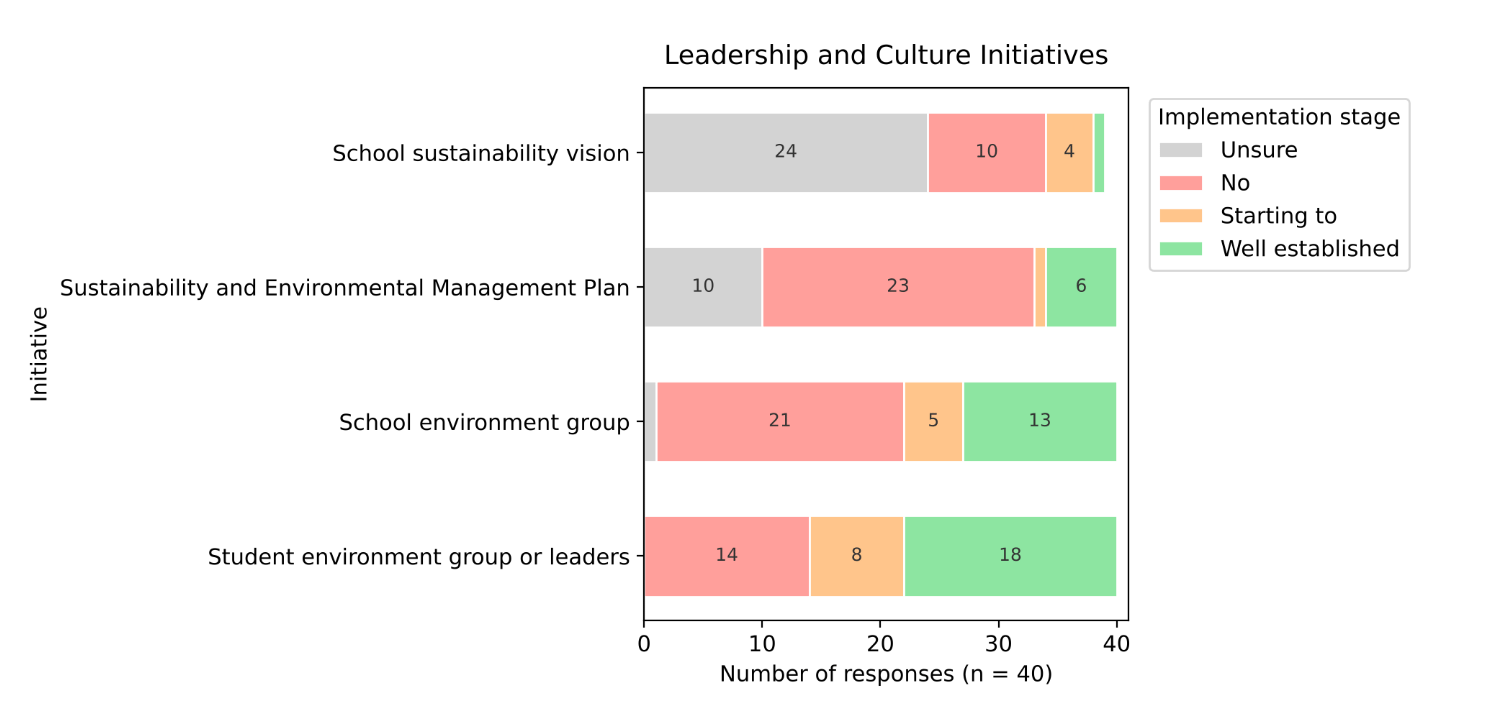
Leadership and culture | Student environment groups or leaders are well established at 45% of schools. | 58% report no Sustainability and Environmental Management Plan (SEMP) and 25% are unsure. 62% are unsure whether their school has a sustainability vision. |
Waste and circular economy | Recycling bins and collection are well established at 70% of schools. | Plastic-free canteens are absent at 88%. Soft plastics recycling is absent at 59%, and Return and Earn at 58%. |
Planning and leadership show the clearest gap. Only 15% of educators report a well-established SEMP, and most are unsure whether their school has a sustainability vision.
Environmental education providers see the same gaps. In the provider survey, school sustainability planning was the gap they cited most, named by about two-thirds of respondents, followed by leadership support from school executives, networking and collaboration, and funding.
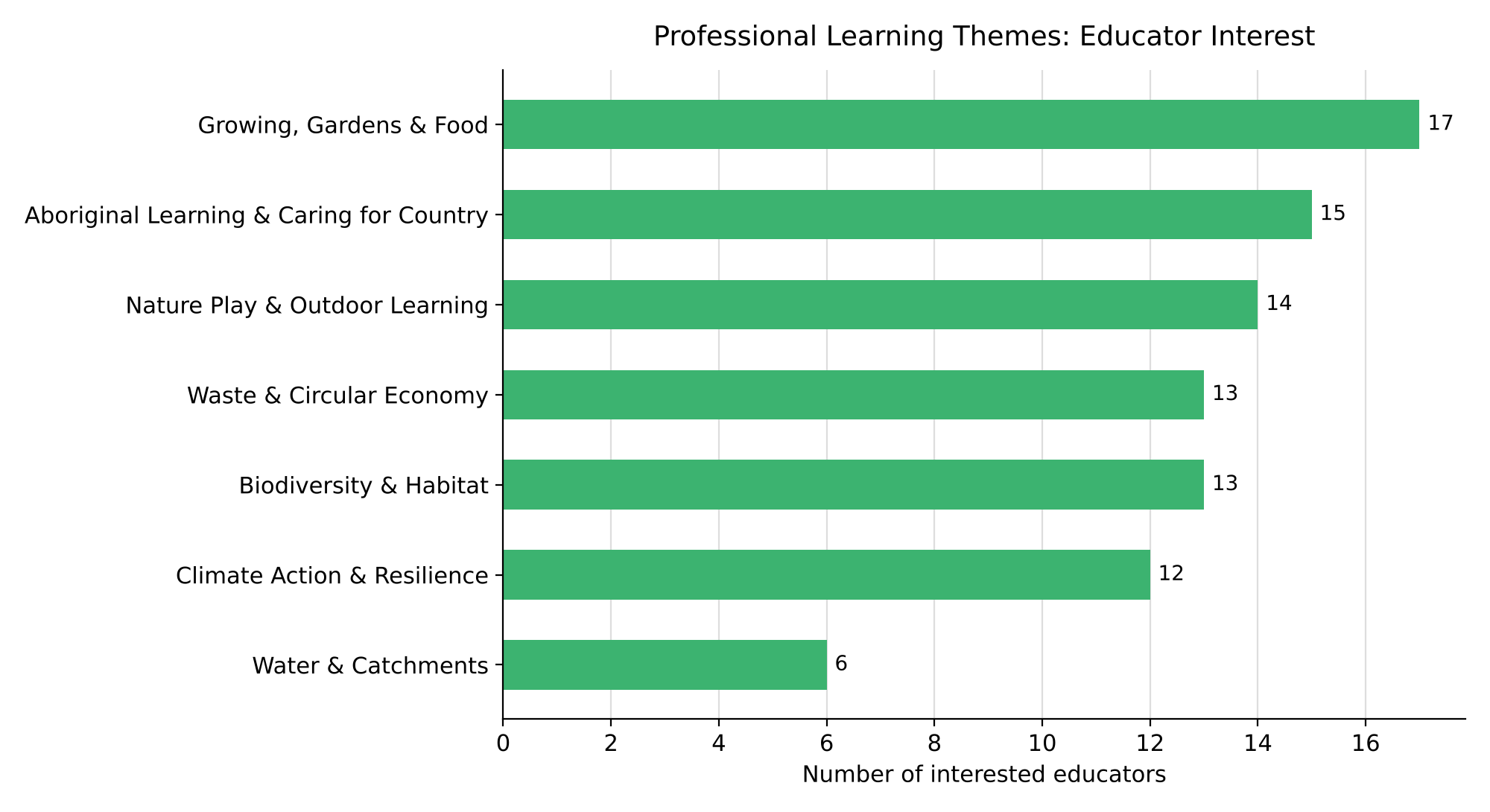
Educators most want hands-on, outdoor and culturally grounded professional learning. Growing, Gardens and Food (17 educators), Aboriginal Learning and Caring for Country (15) and Nature Play and Outdoor Learning (14) were the most popular themes.
The most requested topics were learning about local Aboriginal plants and their uses (12 requests), bush tucker and native food gardens (11), developing bush tucker gardens (10) and outdoor classrooms and learning spaces (9).
The topics educators want most match the gaps the survey found. Caring for Country programs are rare, but demand for training in them is high, which suggests the barrier is support and confidence, not interest. Planning also has strong appetite: 25 educators said they would, or might, like to create a SEMP.
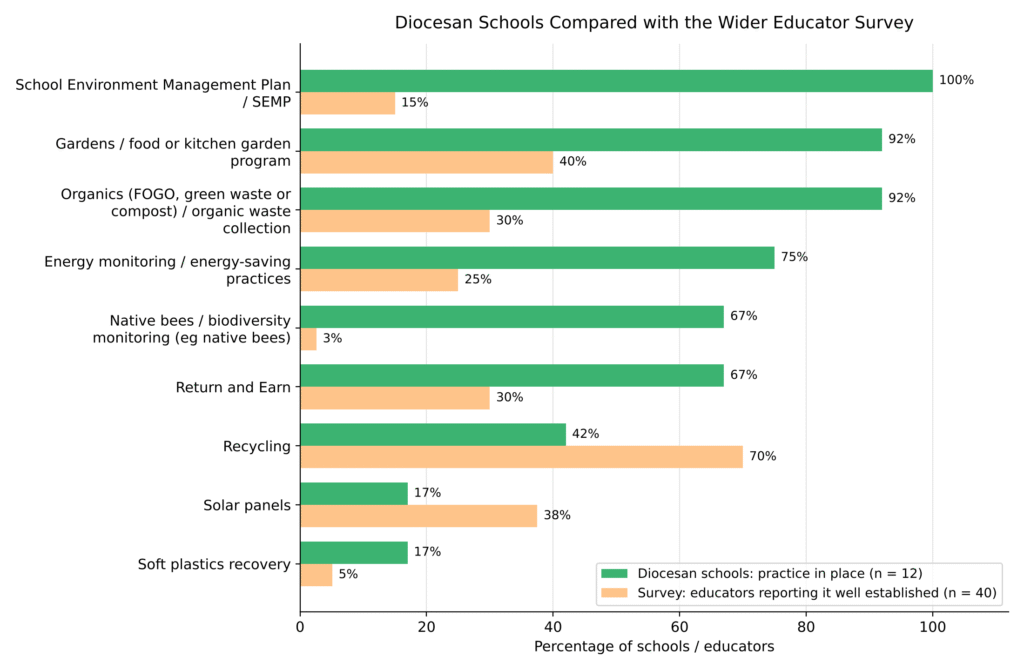
The Catholic Education Diocese of Wollongong shows what a coordinated network can achieve. All 12 diocesan schools in this baseline have a School Environment Management Plan, the diocese’s equivalent of a SEMP, compared with 15% of surveyed educators reporting a well-established SEMP.
The difference is the Wollongong Environment Network (WEN), a Catholic Education Office initiative. Under the diocese’s Environmental Education and Action Policy, every school:
- names a WEN Contact, who takes part in diocesan environmental professional learning
- develops a School Environment Management Plan across seven areas, reviewed every three years
- provides regular outdoor learning, with ecological units in every K–6 year and every Years 7–10 course
On most measures, diocesan schools are well ahead of the wider survey. Gardens and an organics system each run at 11 of the 12 schools, energy monitoring at 9, and native bee projects at 8.
The project’s next stage responds directly to what schools and providers told us:
- An environmental education provider directory. Educators and providers both called for better networking. EENSW is building an online directory so schools can find local providers, incursions and excursions, starting in the Illawarra and expanding statewide.
- School and provider connection events. A series of in-person workshops and online webinars will bring schools and providers together and offer professional learning in the topics educators asked for most.
- A six-school pilot. Six Illawarra schools are co-designing climate education implementation plans, addressing the planning gap the baseline found. Each pilot includes a student excursion or incursion and a climate education resource developed by teachers, to be shared with other schools.
- Shared climate education resources. Resources and case studies from the pilot will be published on the EENSW website.
Schools and educators who want to get involved can contact Environmental Education NSW: project@aaeensw.org.au
