
Program background
Find out about our Sustainable Schools NSW initiative and the broader education sector landscape schools are navigating as they work towards sustainability.
In 2003, the original NSW Sustainable Schools program was started as a pilot program by the NSW Department of Education and Training (DET) and the NSW Department of Environment and Conservation. This government program supported the implementation of the Environmental Education Policy for Schools (2001, DET). Sustainable Schools became part of the Australian Sustainable Schools Initiative (AuSSI), a national partnership program between the Federal and State governments.
In NSW, the Sustainable Schools program delivery initially focussed on implementing School Environment Management Plans (SEMP) and adopted a systems based program, ensuring both management and teaching practises where considered. As the program developed it also promoted holistic Education for Sustainability principles, developing resources on student leadership and promoting an action learning approach. The NSW Government delivered the Sustainable Schools program in various forms for 14 years.
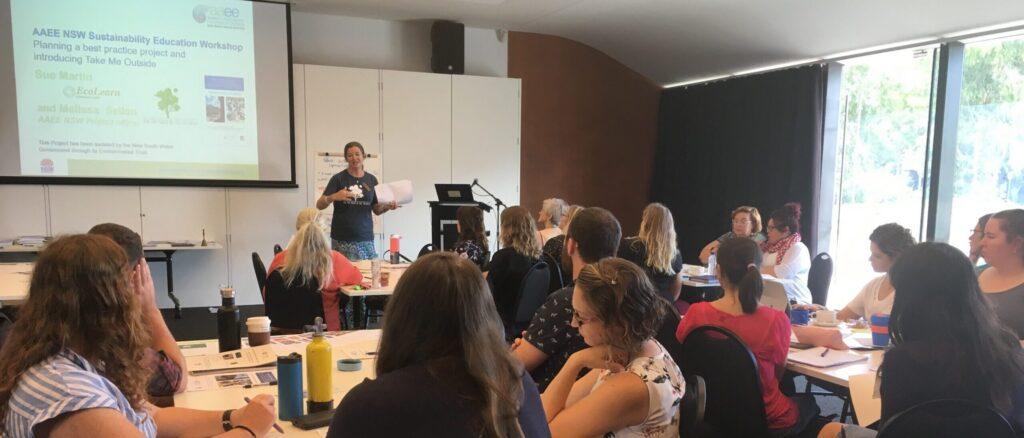
In 2017, the Sustainable School program was transitioned to the Australian Association for Environmental Education NSW Chapter (EE NSW). We wanted to continue the legacy of the Sustainable Schools program, to keep hold of the valuable knowledge and concerted efforts of many NSW environmental educators.
Since EE NSW took over management of Sustainable Schools NSW our focus has been on supporting the environmental education community in NSW to prioritise and promote sustainability education within school communities and their governing bodies.
Sustainable Schools NSW envisions our schools leading the transformation to a sustainable future for all.
Our staff, volunteers and partner organisations work collaboratively to:
- promote and amplify school sustainability initiatives through our regular communications and website
- build alliances between environmental educators who are delivering school education
- link schools with people, organisations and businesses that provide sustainability education, through our Sustainability Connect directory
- support regional networks of sustainability educators
- support the ongoing professional development of school environmental educators
- participate as active members of a range of environmental education advisory groups
- research and understand needs and opportunities for school sustainability in NSW.
NSW Public Schools
The NSW Department of Education (DoE) Commitment to Sustainability was released in November 2022. It establishes a vision to deliver quality education outcomes while protecting the environment, contributing to economic prosperity and helping our communities to thrive. The policy establishes guiding sustainability principles, 5 sustainability priorities, 9 goals to 2030 and 27 actions to 2023.
The NSW DoE Net Zero Road Map is part of the department’s broader commitment to sustainability, working torwards a target to be net zero in operations by 2030. It also aligns with the NSW Government’s commitment to reduce the NSW economy’s overall emissions by 50% on 2005 levels by 2030.
School Infrastructure NSW delivers a range of public school sustainability programs including Solving Organic Waste in Schools Pilot, LED Lighting Upgrade Program, Smart Energy Schools Pilot Program, Cooler Classrooms, Clean Air Schools Program, Sydney WaterFix Schools Program and the (completed) Sustainable Schools Grants Program.
NSW DoE provides advice on integrating sustainability across the curriculum, including teaching and learning resources.
NSW DoE has 25 Environmental and zoo education centres that support learning about sustainability. These centres are located across NSW and are staffed by qualified NSW Department of Education teachers.
Prior to the 2022 policy commitment, NSW public schools were guided by the 2001 Environmental Education Policy for Schools, supported by implementation guidelines that addressed school environment management plans, curriculum, management of school resources and school grounds.
NSW Teachers Federation has a Peace, Environment and International Issues Special Interest Group, a Federation Environment Policy and encourages associations to have an Environment Contact.
NSW Catholic Schools
Catholic schools in NSW operate under the auspices of one of the 11 diocesan Catholic schools officers or one of the 20 religious institutes or ministerial public juridic persons.
Catholic Earthcare Australia is a program of Caritas Australia and is the ecological agency established by the Australian Catholic Bishops Conference in 2002. They engage with the Catholic community, listening to the cry of the earth and the cry of the poor. The Catholic Earthcare Schools program is available to all Catholic schools in Australia. It is a certification program that involves a process of ecological dialogue (conversation), conversion and action.
Laudato Si Action Platform invites schools and other Catholic organisations to begin the journey towards an Integral Ecology. Through the Platform, groups self-assess, reflect and plan how they will work towards the 7 Laudato Si goals.
Wollongong Environment Network is an initiative of the Catholic Education Diocese of Wollongong that supports school communities implement environmental stewardship and sustainability.
Independent Schools
Heads of Independent Co-educational Schools (HICES) support member schools through their sustainability network and annual sustainability expo.
NSW Teachers Federation has a Peace, Environment and International Issues Special Interest Group, a Federation Environment Policy and encourages associations to have an Environment Contact.